










The feed looked like it was being watched through a wet windshield.
A Joint Terminal Attack Controller (JTAC) was lying behind a rock outcropping three klicks south of a compound he’d been watching since before dawn. He had the pattern of life figured out. How many people lived there, when they left, when they came back, and where they parked. Two vehicles had rolled in forty minutes prior, moving faster than locals on the road with no business being busy at that hour. Engines still hot enough to bloom on Infrared (IR). Military-Aged Males (MAMs) had gone inside. The vehicles didn’t belong.
His element had launched an organic Group 2 small unmanned aircraft system (sUAS) twenty minutes earlier. The kind the Army is buying by the thousands right now. Good camera. Decent endurance. It was orbiting the compound at twelve hundred feet Above Ground Level (AGL), close enough to count heads. The JTAC broke out his Remote Operations Video Enhanced Receiver (ROVER), oriented the antenna, powered it up, and pulled the feed.
The compound sat between a tree line to the west and a river running along the eastern edge of the valley. The wind was pushing through the trees and kicking up dust across the open ground. The river surface was doing what water does. Shifting constantly, every pixel different in every frame.
The sUAS had a commercial-grade encoder. The kind a vendor drops in to save cost and shave grams. On the vendor’s Ground Control Station (GCS) at a trade show demo, it looks fine. Out here, the encoder was drowning. Every time the wind moved the trees, the image broke into blocks. Macroblocking. Compression artifacts. The encoder chokes because it compresses video by encoding frame differences, and when the entire frame is in motion (foliage, water, dust), there are no stable references. The bitrate budget gets consumed by visual noise, and the actual target area turns to mush.
The latency made it worse. A properly engineered encoder adds maybe 50 milliseconds of delay. This commercial board was stacking 200-plus. The Sensor Operator (SO) was tracking a guy walking between buildings, and the crosshairs were behind him. What was on the screen had already happened. If you’re trying to walk a sensor onto a target or close a loop, that lag means you’re chasing where he was, not where he is.
Then it dropped frames. The encoder’s processor couldn’t keep up with the load, so it skipped frames to survive. The guy was at the door. Then he was gone. The JTAC didn’t see him go inside because the encoder discarded those frames. In a targeting sequence, a dropped frame at the wrong moment is the difference between Positive Identification (PID) and having to start the whole process over.
But even if the video had been clean. Crystal clear, zero lag, every frame accounted for. The JTAC still couldn’t use it because there were no numbers behind any of it.
No embedded coordinates. No slant range. No sensor position. No platform altitude synced to the image. The ROVER was showing a video with nothing attached. Pictures of a compound in a valley that, as far as the targeting system was concerned, could be anywhere on the planet.
You don’t get to call for fires without a nine-line brief, and a nine-line demands targeting-grade precision. Target grid. Target elevation. Initial Point (IP). Friendlies marked. Egress. The numbers have to be right. Not close. Right. Because the munition that comes off the rail when that nine-line clears does not care about the difference between the right and the wrong building.
The JTAC could see the target. He couldn’t prove its location. He couldn’t build a nine-line from a picture with no grid, not with friendlies three klicks out.
He keyed the radio. Requested an MQ-9 Reaper to reposition into his Area of Responsibility (AOR).
The Reaper was fourteen minutes out.
The MAMs in the compound walked out, got in the vehicles, and drove east.
Gone in eleven.
Same JTAC. Same target. Same war.
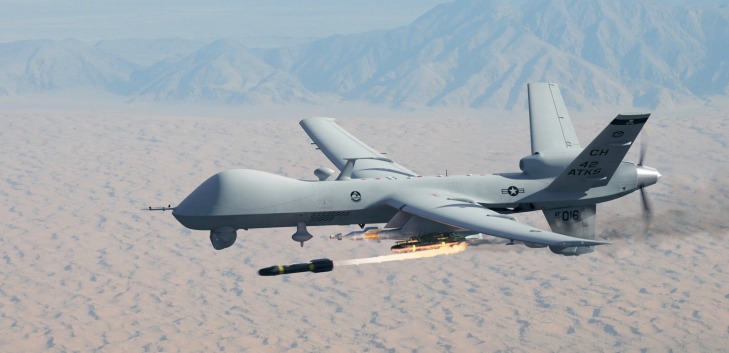
The sUAS had a sensor that could see the compound. An MQ-9 overhead, had it been there, would have given the JTAC everything he needed in seconds. Not because it has a better camera at that range. Because its video encoder produces a standards-compliant stream with targeting-grade metadata embedded frame by frame, and the sUAS encoder produced a mess of artifacts with nothing behind it.
The variable was not the camera. Not the drone. Not the data link. Not the operator. Not the weather. The variable was a piece of hardware smaller than a deck of cards that takes raw sensor output and turns it into something the rest of the force can actually use. That piece of hardware is a video encoder.
A standards-compliant encoder does two things. First, it compresses the video so it fits through a tactical data link without destroying the image. Second, it synchronizes metadata to the video at the point of encoding. Coordinates, time, sensor geometry, platform altitude, slant range, all of it locked to the frame so that every image arriving at a ROVER, a ground station, a coalition terminal, or an analyst’s screen seven thousand miles away carries a precise geographic truth that cannot drift, cannot desync, and cannot be separated from the picture it describes.
If the encoder does both of those things well, the downstream architecture works. The JTAC gets coords he can trust. The nine-line builds. The kill chain closes.
If the encoder does either of those things poorly, or doesn’t do them at all, the architecture is blind. And the target drives away.
There’s a company in Horsham, Pennsylvania, called Delta Digital Video (DDV). It builds video encoders for military Intelligence, Surveillance, and Reconnaissance (ISR) platforms. Not prototypes. Not proposals. Production hardware, fielded and operational, encoding the video the force depends on for targeting and reconnaissance in active theaters. The feed that JTAC needed fourteen minutes away? It was running through a DDV encoder.
That kind of program presence doesn’t happen by accident.
DDV builds for the environments that actually exist. Airborne vibration profiles that turn precision electronics into scrap if the design is wrong. Temperature swings from negative forty to the inside of a fuselage baking on a flight line in midsummer. Bandwidth constraints on tactical data links that punish every wasted bit. And the non-negotiable requirement that metadata and video stay married from the point of encoding all the way to the end user. Because if they drift apart, a JTAC ends up with false confidence in wrong coordinates. That’s how weapons hit the wrong building.
Every certification DDV holds exists because somebody, somewhere, watched a mission fail without it.
The next problem is already here, and it’s math.
Sensors are moving to 4K because the operational need for PID at extended slant ranges demands it. A 1080p sensor at fifteen thousand feet tells you there’s a vehicle in a compound. A 4K sensor at the same altitude tells you what kind. When the difference between a technical with a mounted PKM and a Toyota carrying a family determines whether weapons are released, that distinction is the whole decision.
Data links aren’t getting wider. Satellite communications (SATCOM) allocations are fixed. Tactical links have hard bandwidth ceilings. H.264, the codec that has carried military video for the last decade, can’t push 4K through the same pipe that currently handles 1080p. The bitrates don’t fit.
H.265 cuts the requirement roughly in half at equivalent quality. 4K on a link that previously supported only 1080p. The entire Department of Defense (DoD) is migrating in this direction, and DDV already has the hardware in production. Same size. Same weight class. Same mounting scheme as the encoders already flying. Next-gen codec built in. The box changes. The aircraft doesn’t.
There’s a third codec that matters because it solves a problem H.264 and H.265 can’t.
Both of those codecs compress video by encoding differences between frames. That’s efficient for bandwidth, but it’s also why the JTAC’s feed fell apart over that tree line and river. High-motion, high-complexity scenes overwhelm inter-frame compression. And even when the scene is manageable, inter-frame encoding introduces latency. For watching a feed and making decisions, acceptable. For flying the aircraft, steering the gimbal in real time, or closing a targeting loop, it’s not.
JPEG-XS encodes each frame independently. No dependencies between frames. No error propagation. No cascading artifacts where one bad frame corrupts the next ten. Sub-millisecond latency. It trades compression efficiency for speed and visual resilience in exactly the environments that break the other codecs.
DDV supports JPEG-XS alongside H.264 and H.265 in the same hardware. One encoder serves the exploitation mission and the control mission. One box instead of two on the same aircraft. Most competitors can’t do that.
The Army’s sUAS budget went from $98 million to $782 million in a single fiscal year. Thousands of small drones flooding every echelon from squad to brigade, all carrying sensors, all collecting video, and almost none of them encoding it to the standard the rest of the force requires. The scenario at the top of this article is not hypothetical. It’s happening now, and it’s about to scale.

DDV built an Original Equipment Manufacturer (OEM) module for exactly this problem. A board-level encoder that integrates directly into the camera assembly. Connects to the image sensor. Encodes to standard. Embeds metadata. Encrypts the stream. Outputs it ready for transport. It weighs less than four ounces.
A sUAS equipped with that module produces the same standards-compliant, metadata-rich stream as a platform ten times its size. The ground station doesn’t know and doesn’t care what the feed came from. If the encoding is right, the stream is usable. If it’s wrong, it’s not. At less than four ounces, there is no longer a reason for any platform to fly without one.
Video doesn’t stop being a problem when it reaches the ground. Ground stations, Tactical Operations Centers (TOCs), and shipboard Combat Information Centers (CICs) receive feeds from multiple platforms simultaneously. Different aircraft, different sensors, different codecs, different resolutions, different protocols. The last mile of the video chain is a distribution problem, and it’s every bit as unforgiving as the airborne encoding problem.

DDV builds multi-channel distribution systems that decode, synchronize, and distribute up to 15 simultaneous feeds with time-correlated sync across all channels. The Navy selected DDV’s distribution system for integration on surface combatants. The same company’s hardware covers the path from the sensor on the aircraft to the screen in the TOC. Same standards. Same metadata handling. Every node in the chain.
The Marine Corps published something in March 2026 that should bother everyone in this space: ‘The targeting data is perfect, captured with high fidelity, yet it remains a fleeting digital image on a single screen.’
The Army’s 2nd Cavalry Regiment issued warnings the same month about cognitive overload from incompatible sensor formats. Every sensor spits data in a different schema. Every handoff requires manual transcription. Soldiers drowning in video they can’t fuse, can’t share, can’t act on at the speed the fight demands.
These aren’t technology problems. They’re encoding problems. They aren’t new. They’re just finally being said out loud by the people who’ve been living with them.
That JTAC behind the rock didn’t lose the target because his drone couldn’t see. He lost it because the video his drone produced was unusable to everyone else in the kill chain. A four-ounce encoder would have changed the outcome.
That is what Delta Digital Video builds. Not for recognition. Not for credit. For the seconds that decide whether the kill chain closes or the target drives away.
Those seconds are worth getting right.